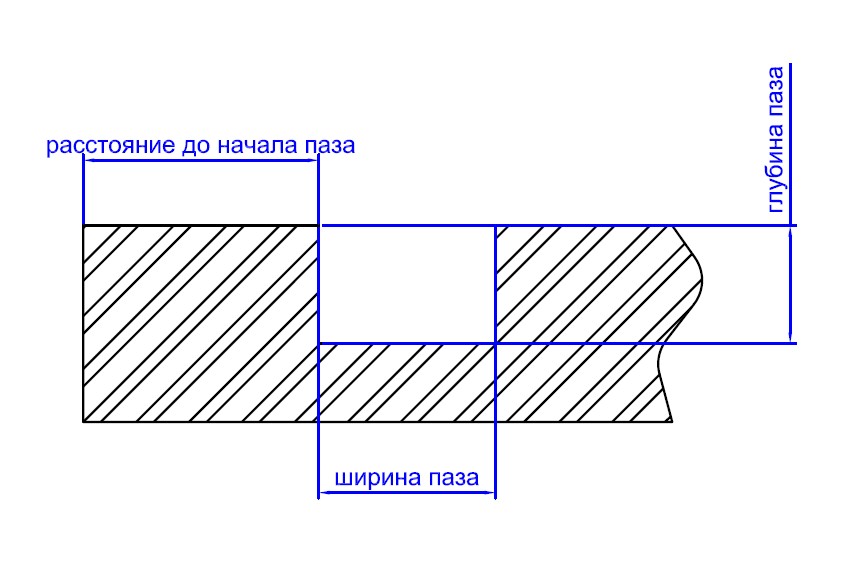
Grooving is done with a saw or cutter on 6 sides.
The cutter is used:
- if the groove width is greater than the default cutter diameter;
- with “quarters” - grooves with 0 indentation from the edge.
Types of groove: open - made after edging , closed - made before edging .
If a closed groove is made with a saw (the width of the groove is less than the diameter of the cutter), when setting the desired parameter, the entry and exit points of the saw will automatically be shifted so that the saw does not go further than necessary. Example: if the saw has a diameter of 120 mm, the exit point is set to 50. The 50 mm point is the location of the center of the saw, respectively, the actual cut will be further away.
If the closed slot is made with a milling cutter, it is unloaded with a notch in the TNC programs.
The system automatically adjusts the entry and exit so that the saw does not touch the material further/closer than the set values.
Keep in mind that on a part it is worth making all the grooves open or all closed. In a mixed version, production will be very difficult or, in principle, impossible.
The end grooves are made with a milling cutter. The manufacturing company sets the parameters of such a cutter, and when the program is unloaded, the groove will be converted into milling.
The groove is specified by the parameters:
- Party of operation;
- Saw thickness;
- Groove width;
- Groove type;
- Groove depth;
- Distance TO THE BEGINNING of the groove (overall dimensions) and Which side to indent from;
- Indents from the edge of the part for a Closed groove.